OPEN STANDARDS FOR CULTURAL DIGITAL INFRASTRUCTURE
A Shared Framework for Trusted Cultural Digital Assets
The standards are intended to provide artists, museums, archives, universities, foundations, collectors, cultural organizations, and technology providers with a shared institutional language for Cultural Digital Infrastructure.
Physical Cultural Objects (PCO)
- Physical Artistic Object (PAO)
- PCO Candidate
- Physical Cultural Object (PCO)
The Organization recognizes that the normative content of these categories—including definitions, evaluation criteria, evidence requirements, governance models, recognition procedures, and transition mechanisms—requires dedicated research before becoming part of an international standard.
This research is currently being conducted within the ANDRBEL Research Program, through DAP #0A, and will inform future versions of the CDA Protocol.
Upon completion of the research and subsequent protocol adoption, these standards will be available for voluntary use by museums, galleries, artists, collectors, auction houses, foundations, and other participants in the international cultural sector.


Open standards do not prescribe a single platform.
They establish the shared conditions through which many systems can work together.
#why-standards
1. Why Open Standards Are Needed
From Fragmented Systems to Shared Cultural Infrastructure
Digital culture is currently supported by a growing number of platforms, registries, blockchain networks, archives, certification systems, and governance models.
Many of these systems operate independently.
They use different:
- definitions;
- data structures;
- identity models;
- governance mechanisms;
- documentation practices;
- verification methods;
- preservation strategies;
- technical infrastructures.
This fragmentation limits institutional trust and makes long-term cultural continuity difficult.
An open standard creates a shared foundation without requiring every organization to use the same technology or platform.
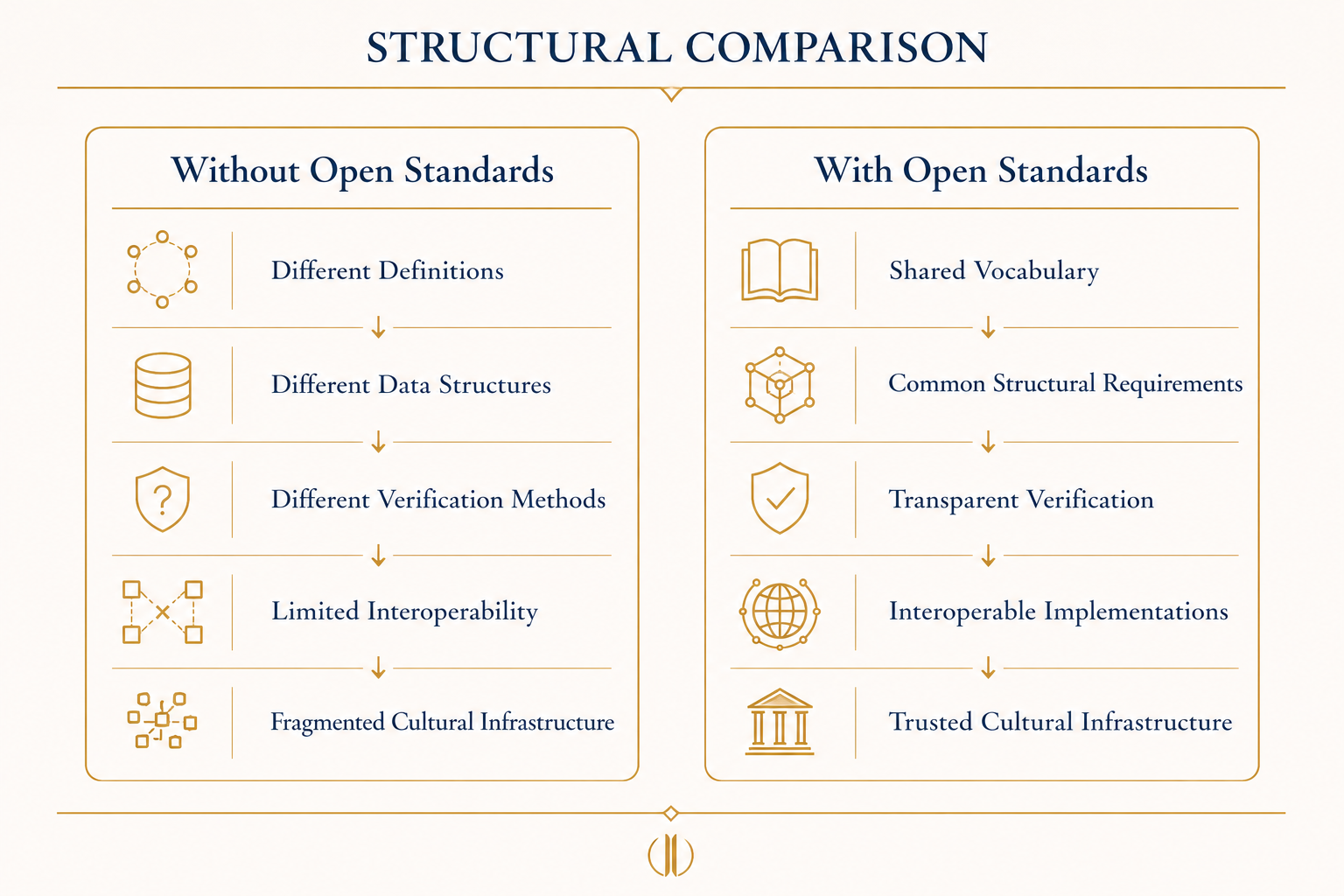
The purpose of a standard is not to centralize cultural infrastructure.
It is to make independent infrastructures structurally compatible.
#cda-protocol
2. The CDA Protocol
The Open Standard for Cultural Digital Assets
The CDA Protocol is the principal standards framework developed under the stewardship of the CDA Standards Organization.
It defines the common structural requirements through which a digital asset may be documented, governed, verified, implemented, and preserved as a Cultural Digital Asset.
A Cultural Digital Asset is not evaluated solely through ownership, market activity, or technological functionality.
It is understood as a digital instrument designed to generate, preserve, or extend cultural value through participation, knowledge, governance, infrastructure, and continuity.
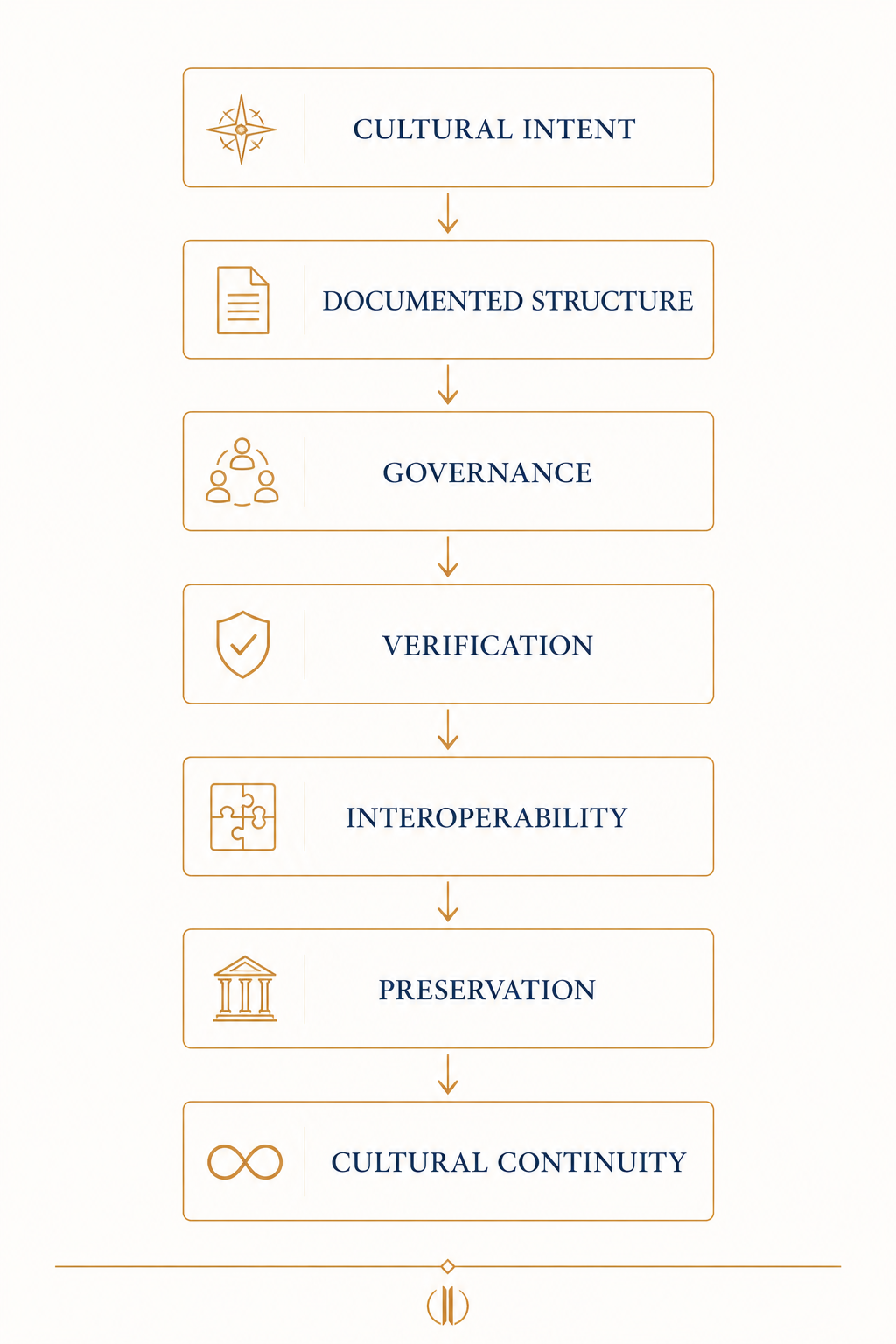
The CDA Protocol establishes a shared institutional framework for describing, governing, verifying, and preserving Cultural Digital Assets across independent cultural and technological systems.
#scope
3. What the CDA Protocol Standardizes
A Common Structure Without a Single Technology
The CDA Protocol does not prescribe one blockchain, one software provider, one registry, or one commercial platform.
It standardizes the structural information and institutional conditions required for Cultural Digital Assets to remain understandable, verifiable, transferable, and preservable across different implementations.
Core Standards Domains
01
01 — Identity and Classification
Defines how a Cultural Digital Asset is identified and distinguished from other types of digital assets.
Potential elements include:
- unique asset identifier;
- title and designation;
- asset category;
- originating cultural project;
- creator or issuing institution;
- creation and issuance date;
- version and status;
- relationship to physical or digital source material.
02
02 — Cultural Purpose
Documents why the asset exists within a cultural ecosystem.
Potential elements include:
- cultural purpose;
- public-interest objective;
- artistic or institutional context;
- educational function;
- research function;
- preservation function;
- intended communities and beneficiaries.
This domain reflects the Principle of Cultural Primacy: technology serves cultural, educational, institutional, and societal purposes rather than replacing them.
03
03 — Utility Structure
Defines how meaningful utility is created within the cultural ecosystem.
Utility is not reduced to isolated functions such as access, payment, rewards, or voting. It is evaluated through the relationships the asset supports across participation, education, experimentation, research, infrastructure, and continuity.
Potential elements include:
- participation mechanisms;
- educational utility;
- research contribution;
- institutional utility;
- infrastructural utility;
- continuity function.
04
04 — Governance Structure
Defines how responsibility and decision-making are organized.
Potential elements include:
- responsible governing body;
- decision-making authority;
- participation rights;
- review procedures;
- conflict-of-interest disclosures;
- amendment mechanisms;
- succession arrangements;
- institutional stewardship.
Digital Governance has already been defined within ADAS as the transparent organization of responsibilities, decision-making, participation, and institutional continuity.
05
05 — Trust and Verification
Defines the evidence required to make structural claims verifiable.
Potential elements include:
- issuer verification;
- creator verification;
- provenance records;
- documentation sources;
- technical verification;
- governance records;
- public disclosures;
- independent review status;
- record integrity.
06
06 — Economic Structure
Documents how economic mechanisms support rather than replace cultural purpose.
Potential elements include:
- issuance model;
- allocation structure;
- circulation rules;
- revenue purpose;
- treasury governance;
- economic rights;
- transfer restrictions;
- financial disclosures;
- long-term sustainability mechanisms.
The standard should not prescribe one economic model. It should require that the chosen model be transparent and structurally aligned with the declared cultural purpose.
07
07 — Interoperability
Defines how Cultural Digital Assets and their records can operate across independent systems.
Potential elements include:
- standardized metadata;
- portable identifiers;
- machine-readable records;
- common terminology;
- data export;
- registry interoperability;
- cross-platform verification;
- implementation compatibility.
The ADAS research identifies interoperability, registries, documentation systems, institutional standards, and preservation systems as essential components of durable cultural infrastructure.
08
08 — Preservation and Continuity
Defines how the asset, its records, governance, and cultural meaning remain accessible over time.
Potential elements include:
- preservation responsibility;
- storage and redundancy;
- metadata permanence;
- migration procedures;
- governance succession;
- institutional stewardship;
- deprecation procedures;
- recovery mechanisms;
- long-term public accessibility.
Within ADAS, continuity is not passive storage. It is the capacity of a cultural ecosystem to continue generating and transmitting value beyond individual projects, participants, or technologies.
09
09 — Compliance and Structural Legitimacy
Defines how conformity with the protocol may be documented and independently evaluated.
Potential elements include:
- required and optional attributes;
- conformance statements;
- implementation evidence;
- review status;
- known limitations;
- disclosure of exceptions;
- version compatibility;
- independent verification.
Compliance here should not be presented as universal legal certification.
It refers to demonstrated conformance with the structural requirements of the CDA Protocol.
#record-structure
4. The CDA Record Structure
One Cultural Digital Asset. Two Complementary Records.
This section should reflect our latest distinction between research and registration.
The CDA Protocol does not itself conduct research or produce scientific conclusions.
It registers the Cultural Digital Asset and presents two complementary records.
Technical and Institutional Record
Registry Card
The Registry Card documents the asset as a registered cultural digital structure.
It may include:
- unique CDA identifier;
- creator or issuing institution;
- cultural purpose;
- technological implementation;
- network or infrastructure;
- governance structure;
- ownership and provenance;
- verification status;
- version history;
- preservation information;
- conformance status.
Structural Research Record
Research Card
The Research Card presents the relevant Structural Research Record — SRR connected to the asset.
It may include:
- research question;
- applied research framework;
- research attributes;
- methodology;
- observations;
- structural assessment;
- limitations;
- version;
- responsible research program.
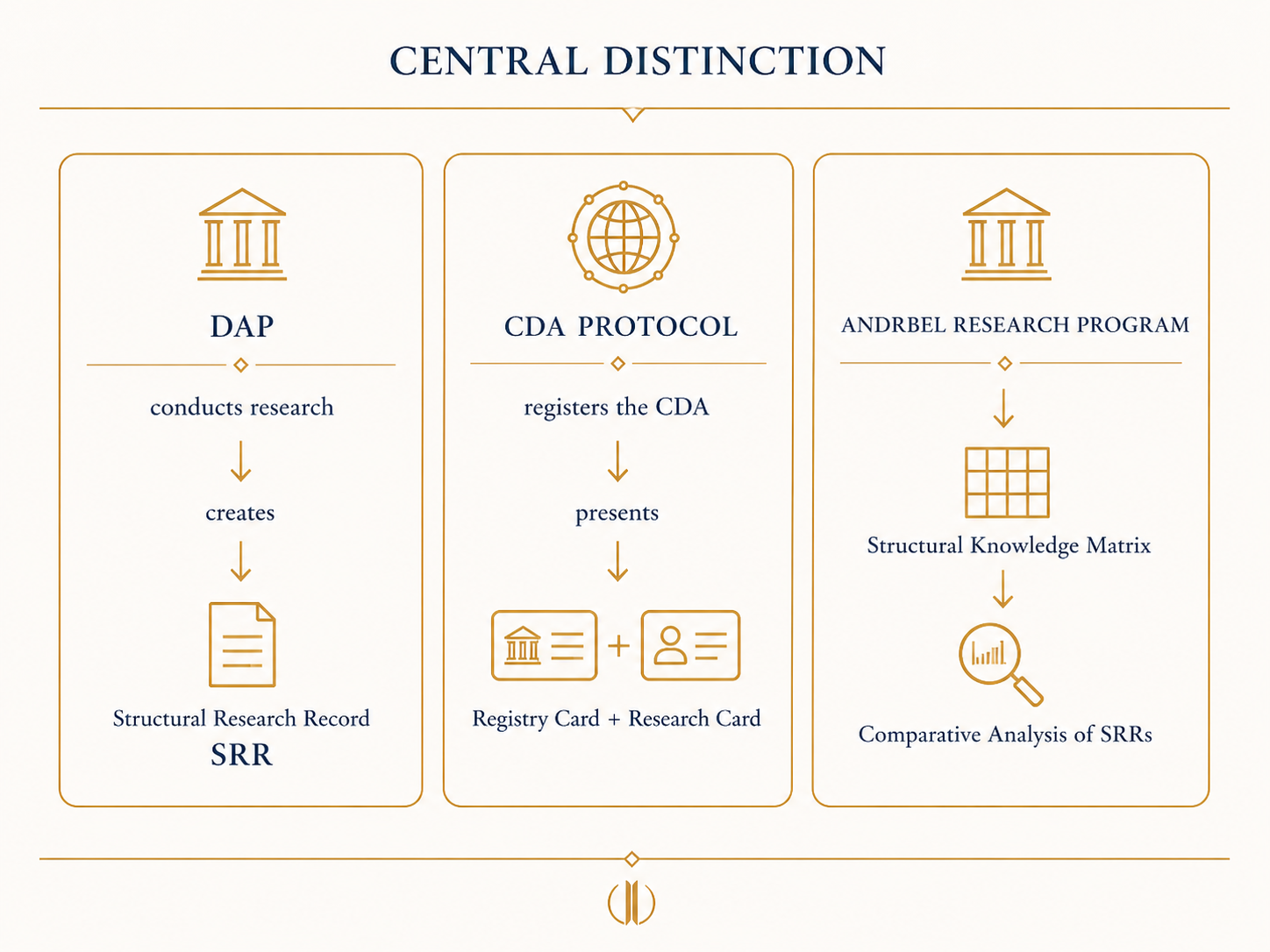
This prevents three functions from being confused:
- the DAP investigates;
- the CDA Protocol registers and discloses;
- the Structural Knowledge Matrix compares research records.
The registry records structural claims.
Research investigates them.
Neither function should replace the other.
#principles
5. Principles of the CDA Protocol
Standards Grounded in Cultural Responsibility
The CDA Protocol should be governed by a concise set of foundational principles.
Principle 01 — Cultural Primacy
Cultural purpose precedes technological and financial implementation.
Principle 02 — Openness
The standard is publicly accessible and available for independent implementation.
Principle 03 — Institutional Neutrality
No single commercial implementation owns or controls the standard.
Principle 04 — Transparency
Governance, documentation, methodology, limitations, and conformance claims must be visible and understandable.
Principle 05 — Interoperability
The standard must support exchange between independent systems rather than create technological dependency.
Principle 06 — Verifiability
Structural claims must be supported by identifiable evidence and reviewable records.
Principle 07 — Proportionality
Requirements should reflect the scale, purpose, risk, and institutional context of the implementation.
Principle 08 — Preservation
The standard must support exchange between independent systems rather than create technological dependency.
Principle 09 — Continuity
The standard must address how assets, responsibilities, records, and institutional memory continue over time.
Principle 10 — Evolution
The protocol must be capable of documented revision without losing historical versions or institutional coherence.
#boundaries
6. What the Standard Does Not Do
Clear Boundaries Protect Institutional Trust
The CDA Protocol does not:
- determine whether an artwork is culturally valuable;
- evaluate artistic quality;
- guarantee financial performance;
- issue investment advice;
- replace applicable laws or regulations;
- prescribe a single blockchain;
- require a particular commercial platform;
- transfer ownership of cultural assets;
- replace museums, archives, universities, or cultural authorities;
- provide automatic institutional recognition;
- make scientific conclusions on behalf of research programs.
The CDA Protocol standardizes structures and disclosures.
It does not standardize culture itself.
#standards-architecture
7. Standards Architecture
From Foundational Research to Implementable Standards
A principle enters the CDA Protocol only after it has been:
- defined;
- reviewed;
- tested;
- documented;
- translated into an implementable requirement;
- approved through the standards governance process.
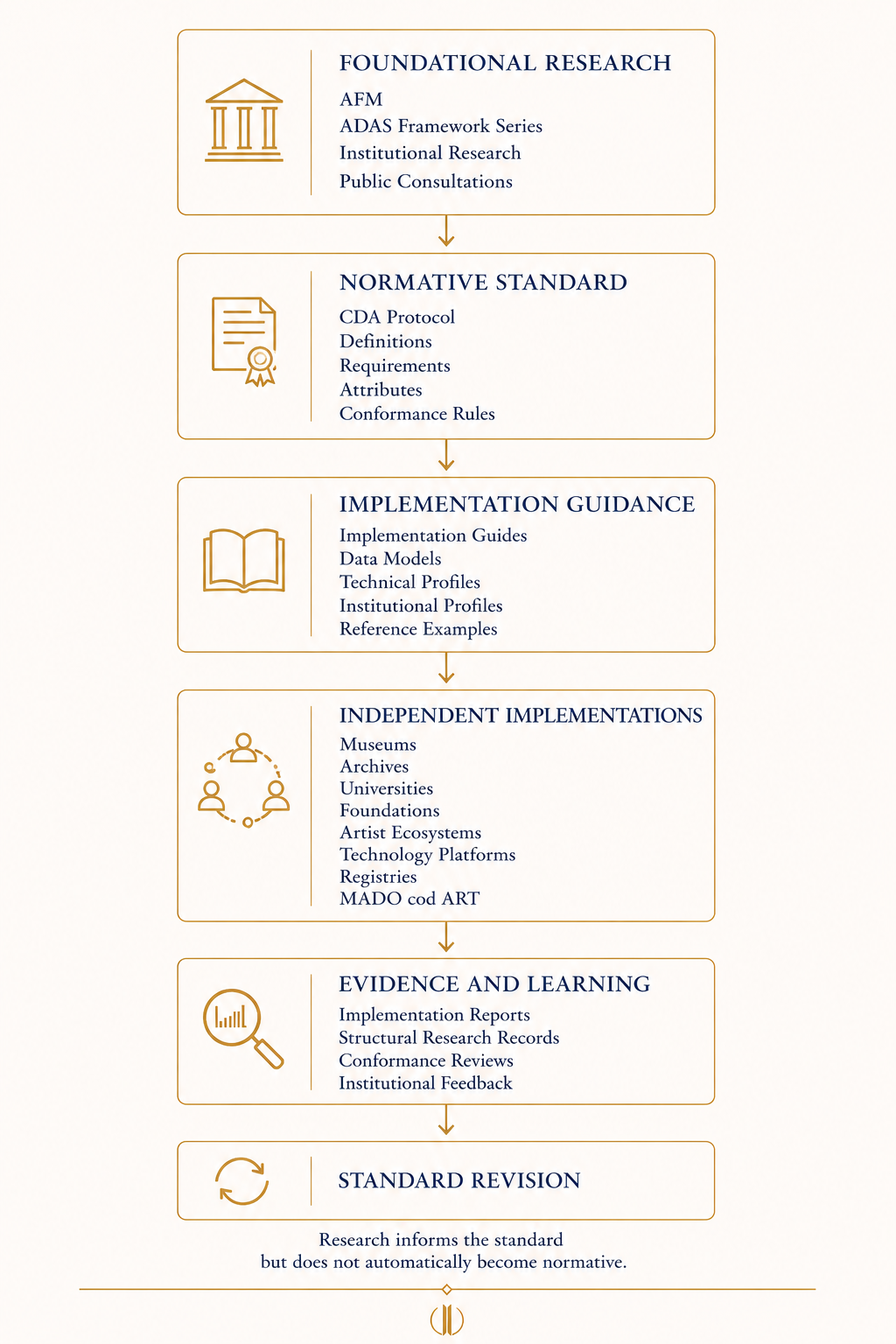
Research may propose.
The standards process must evaluate.
The Organization must govern.
#standards-lifecycle
8. Standards Lifecycle
How an Open Standard Develops
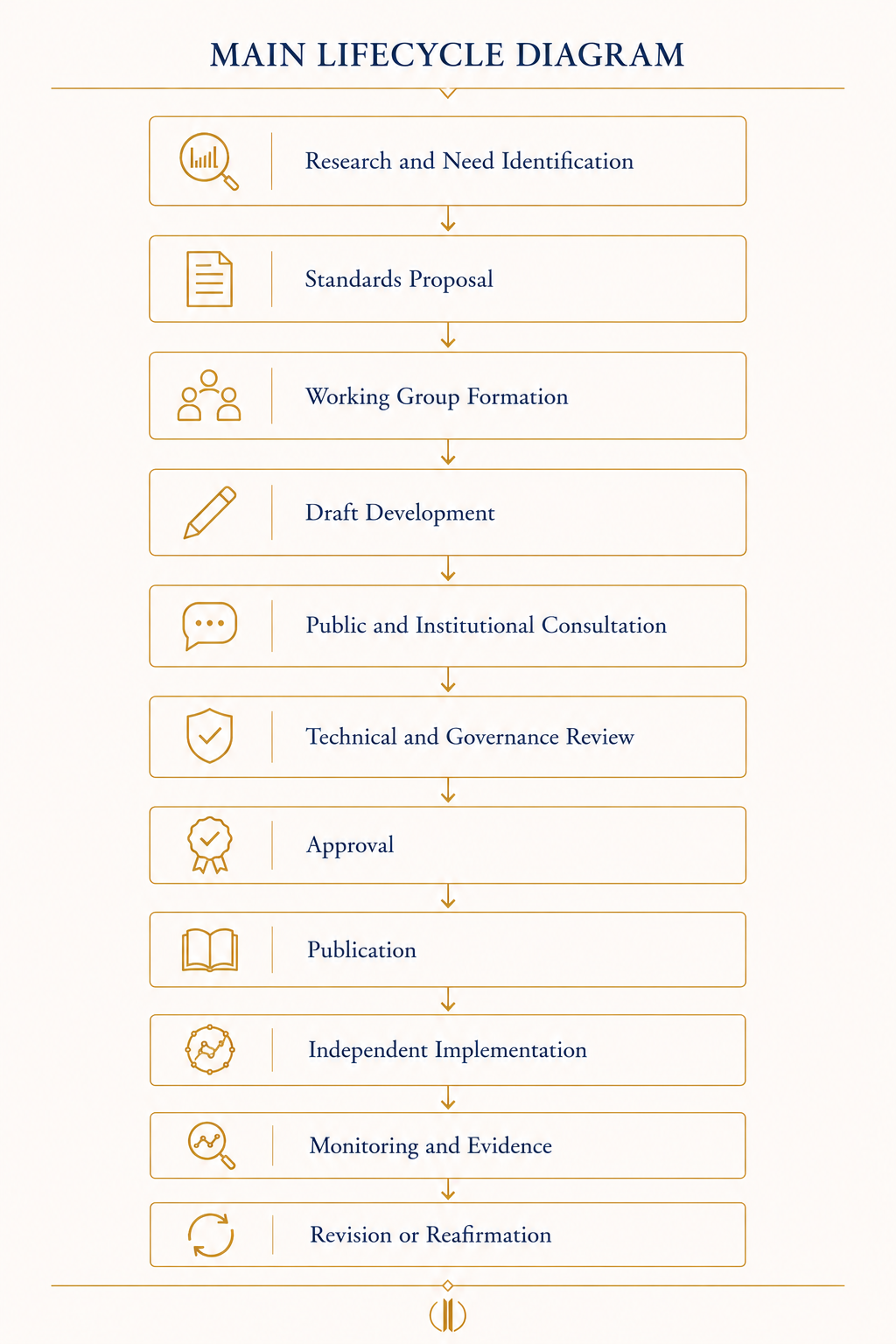
The CDA Protocol should not be presented as a document written once and then permanently fixed.
It is a governed institutional process.
Stage 1 — Research and Need Identification
A structural problem, implementation gap, or new institutional requirement is identified through research, implementation evidence, or stakeholder consultation.
Stage 2 — Standards Proposal
A formal proposal defines:
- the problem;
- affected stakeholders;
- proposed scope;
- expected public benefit;
- relationship to existing standards;
- anticipated implementation impact.
Stage 3 — Working Group Formation
A multidisciplinary Working Group may include representatives from:
- cultural institutions;
- research organizations;
- technology providers;
- archives and preservation communities;
- legal and governance fields;
- artists and cultural communities.
Stage 4 — Draft Development
The Working Group prepares a documented draft containing definitions, requirements, attributes, conformance rules, and known limitations.
Stage 5 — Public and Institutional Consultation
Relevant communities are invited to review the draft.
Consultation records should be documented and published where appropriate.
Stage 6 — Review
The draft undergoes:
- structural review;
- governance review;
- technical review;
- interoperability review;
- preservation review;
- conflict-of-interest review.
Stage 7 — Approval
Approval follows the formal governance procedures of the CDA Standards Organization.
Founding status or financial contribution must not provide unilateral approval authority.
Stage 8 — Publication
Approved standards are published with:
- version number;
- effective date;
- change history;
- conformance guidance;
- implementation materials;
- governance record.
Stage 9 — Implementation and Monitoring
Independent institutions and platforms apply the standard and generate practical evidence.
Stage 10 — Revision, Reaffirmation, or Withdrawal
The standard may be:
- reaffirmed;
- amended;
- superseded;
- deprecated;
- withdrawn.
#versions
9. Versioning and Status
Every Standard Has a Public Institutional Status
Each standards document should display a clear status.
Every published version includes
- document title;
- document identifier;
- version number;
- publication date;
- current status;
- responsible Working Group;
- approval record;
- previous and subsequent versions;
- implementation notes;
- known limitations;
- licensing terms.
Identifier logic - CDA Protocol v1.0 — In Development
#conformance
10. Conformance
Transparent Conformance Without Platform Dependence
An organization may implement the CDA Protocol independently.
Conformance does not require the use of software owned by the CDA Standards Organization.
A conformance statement should indicate:
- protocol version;
- applicable profile;
- mandatory attributes implemented;
- optional attributes implemented;
- known exclusions;
- verification method;
- date of assessment;
- responsible organization;
- independent review status.
Self-Declared Conformance
The implementing organization publishes its own structured conformance statement.
Reviewed Conformance
The implementation has been reviewed through an approved assessment process.
Independently Verified Conformance
An authorized independent body has evaluated the implementation evidence.
Future conformance and verification mechanisms will be developed through institutional consultation and published governance procedures.
#implementations
11. Who Can Implement the CDA Protocol
One Standard. Many Independent Implementations.
The CDA Protocol is intended for use across diverse cultural environments.
Artists and Artist-Led Ecosystems
To document cultural purpose, governance, utility, provenance, research, and continuity.
Museums and Cultural Institutions
To register, acquire, preserve, interpret, and exchange Cultural Digital Assets using a shared framework.
Archives and Libraries
To support structured documentation, metadata portability, preservation responsibility, and long-term accessibility.
Universities and Research Organizations
To study, test, critique, and extend Cultural Digital Infrastructure through documented research.
Foundations
To evaluate cultural purpose, governance, public benefit, institutional capacity, and long-term continuity.
Collectors and Collections
To preserve verified records, provenance, rights, governance information, and transfer history.
Technology Providers
To build registries, platforms, wallets, preservation tools, verification systems, and interoperability layers compatible with the standard.
Independent Commercial Implementations
To implement CDA Protocol requirements without acquiring ownership or control of the standard.
MADO cod ART
MADO cod ART may operate as an independent reference and enterprise implementation of the CDA Protocol.
It must not be presented as the exclusive implementation.
#independence
12. Institutional Independence
The Standard and Its Implementations Remain Separate
The Organization does
- develop the standard;
- maintain definitions and requirements;
- coordinate Working Groups;
- organize consultation;
- publish versions;
- preserve standards history;
- govern revision procedures.
- own every implementation;
- privilege one technology provider;
- guarantee one commercial platform;
- sell influence over normative requirements;
- permit funding to determine technical outcomes.
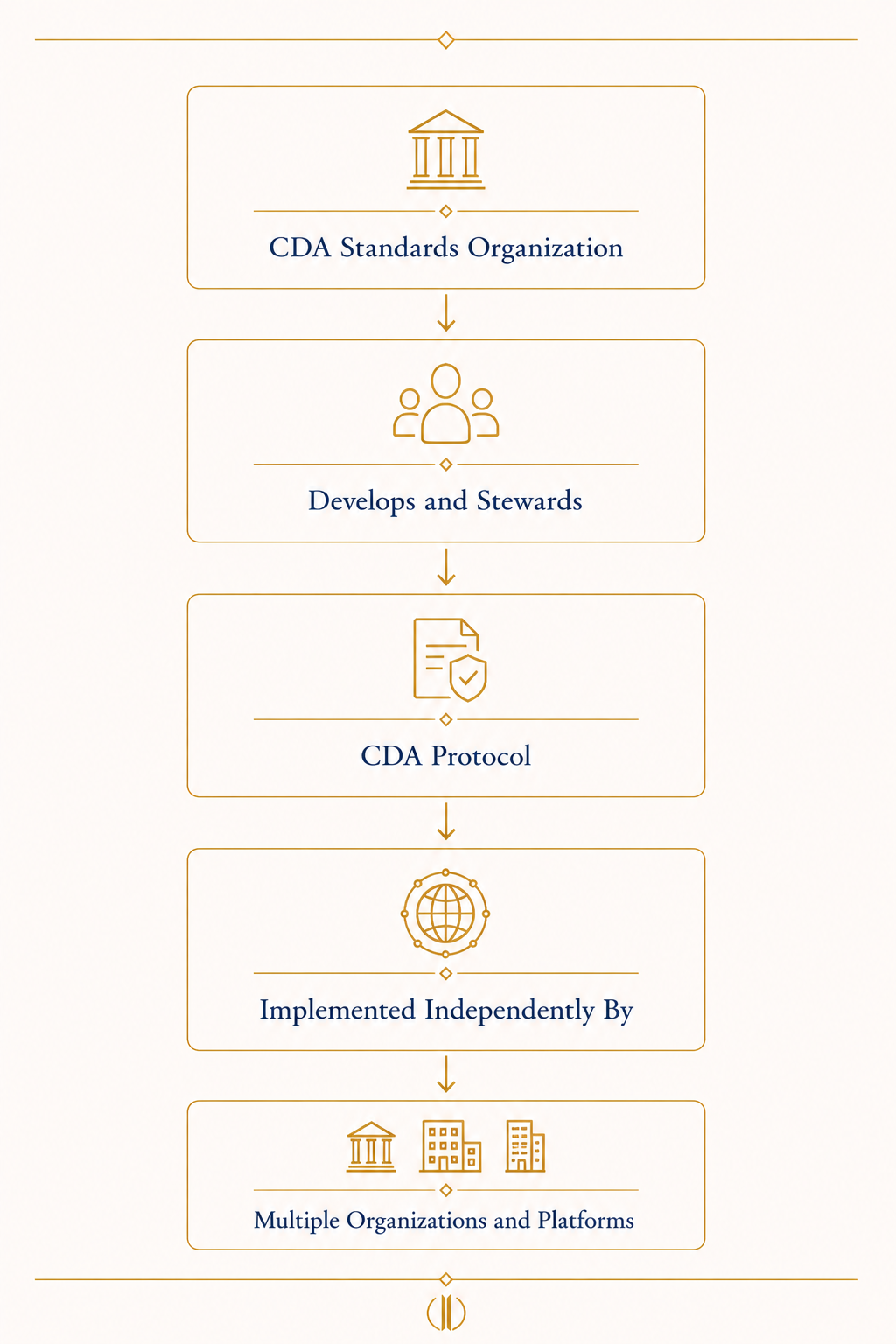
Financial or institutional support may help establish the standards organization.
It does not purchase control over the standard.
#participate
13. Participation in Standards Development
Open Contribution. Governed Decision-Making.
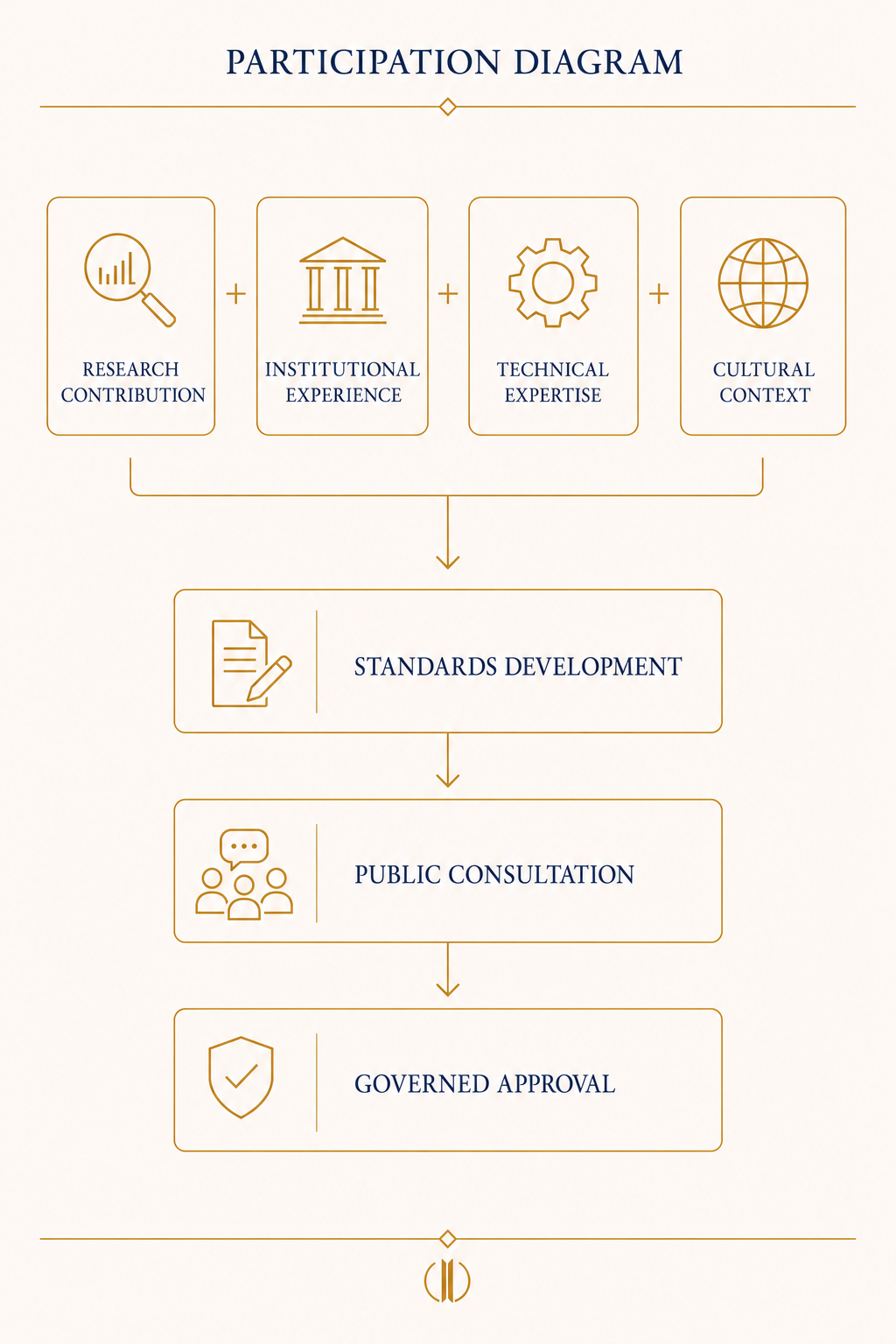
The standards process should be open to relevant expertise while remaining institutionally governed.
Possible forms of participation include:
- submitting research;
- proposing a standards issue;
- responding to public consultation;
- nominating an expert;
- joining a Working Group;
- providing an implementation case;
- testing a draft;
- submitting interoperability feedback;
- identifying preservation risks;
- contributing multilingual or regional expertise.
#current-program
14. Current Standards Program
CDA Protocol v1.0
Status: In Development
Domain: Cultural Digital Assets
Steward: CDA Standards Organization
Research Foundation: ADAS Framework Series
Implementation Model: Open and technology-independent
Current development areas
- terminology and definitions;
- CDA classification;
- minimum registry attributes;
- cultural-purpose disclosures;
- governance attributes;
- trust and verification attributes;
- utility documentation;
- economic structure disclosures;
- interoperability requirements;
- preservation and continuity requirements;
- Research Card and SRR relationship;
- conformance model;
- versioning and lifecycle procedures.
Document card
CDA Protocol v1.0
Open Standards Framework for Cultural Digital Assets
Status: Institutional Development Draft
#research-foundation
15. Research Foundation
Standards Informed by Research
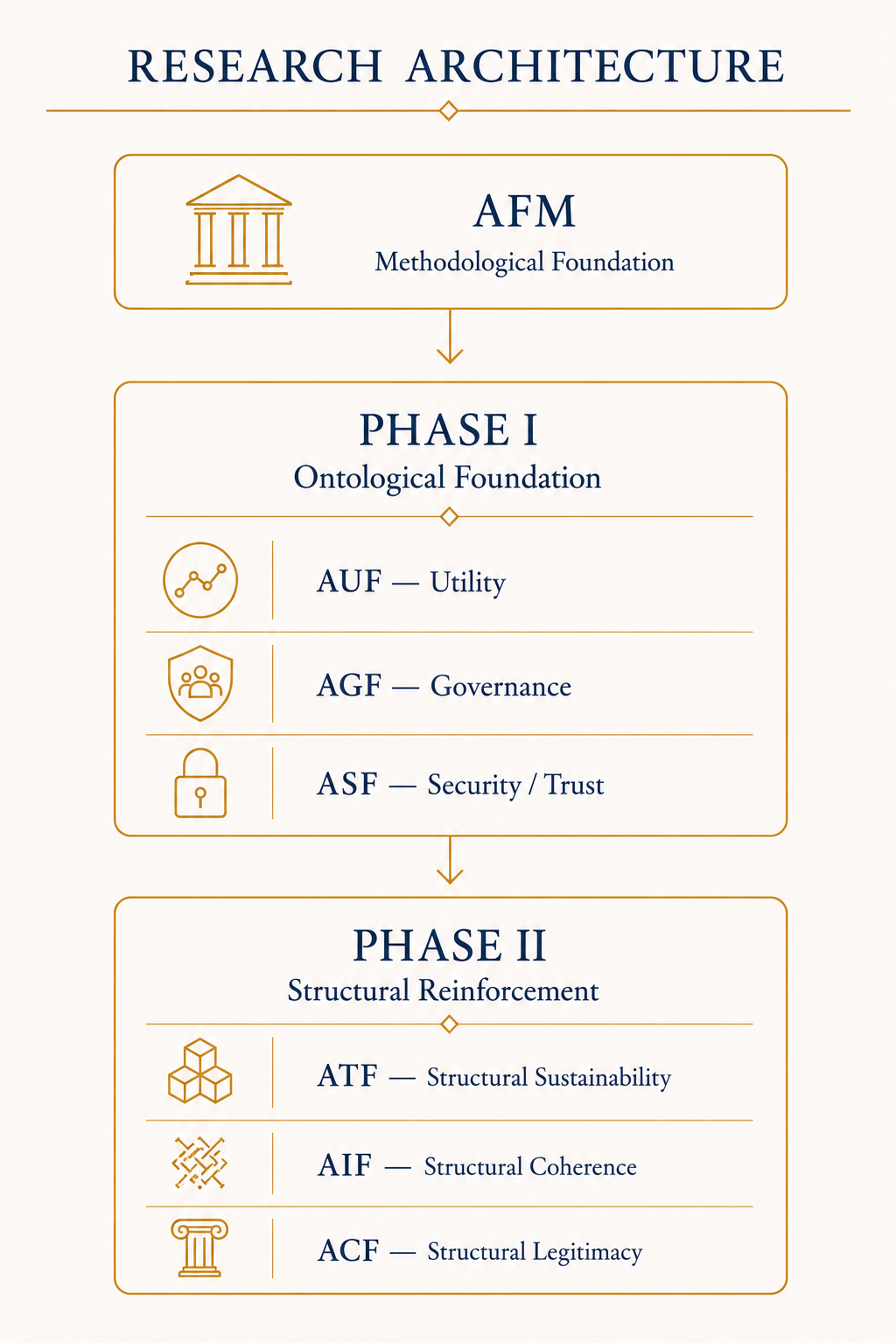
The CDA Protocol is informed by the ADAS Framework Series, which investigates the structural conditions through which trusted cultural infrastructures establish Utility, Governance, Trust, Structural Sustainability, Structural Coherence, and Structural Legitimacy.
Important clarification
The ADAS Framework Series is not itself the CDA Protocol.
It provides:
- research questions;
- conceptual definitions;
- structural models;
- comparative attributes;
- methodological foundations.
The CDA Protocol provides:
- normative definitions;
- minimum requirements;
- registry attributes;
- conformance rules;
- implementation guidance;
- standards governance.

#documents
16. Publications and Public Documents
Standards Documents
Available or planned document types
- CDA Protocol;
- Standards Architecture;
- CDA Charter;
- Standards Development Procedure;
- Working Group Terms;
- Public Consultation Procedure;
- Conformance Framework;
- Implementation Guides;
- Technical Profiles;
- Institutional Profiles;
- Version History;
- Governance Decisions.


17. Final Institutional Statement
A Standard Becomes Valuable When It Can Be Shared
The future of Cultural Digital Infrastructure should not depend upon isolated platforms, incompatible records, or proprietary definitions.
It requires a common structural foundation that institutions can examine, implement, challenge, and improve together.
The CDA Standards Organization exists to provide that foundation.
One open standard.
Many independent implementations.
A shared cultural infrastructure.


CDA Protocol v1.0 is currently being developed as an open standards framework through research, institutional consultation, and future implementation testing.